
Webb County Three-Day Releases
No Webb County Sheriff page publishes people released in a rolling 72-hour period. The nearby official product is the 48-hour Booking Jail Search. It describes arrests, not exits from custody. Its presence must not be treated as evidence that a release list exists.
A three-day release review therefore works as a record-reconciliation task. First identify each booking that may fall in the period. Then find a dated release event, court disposition, VINE notice, or direct jail confirmation. If Webb County Jail transferred the person to TDCJ, federal authorities, or ICE, the county episode ended but confinement did not.
Check Webb 72-Hour Releases
Use full calendar dates rather than the phrase “three days ago.” That keeps weekend and overnight events clear. Match the booking by number whenever possible. Names alone are risky in Webb County because compound surnames, aliases, hyphens, and different surname order may appear across jail and court systems.
- Review the Webb Jail and Bond Record Search for the booking and any explicit status or release value.
- Call Webb County Jail at 956-523-4400. Give the booking number and ask whether a completed release or transfer event falls in the chosen date range.
- Check Texas VINE for recent county-custody events and confirm any alert with the jail.
- Read the Webb criminal case for bond orders, dismissal, judgment, sentence, or jail credit.
- Request the custody history and release transaction through the Webb County PIO if no online source supplies direct proof.
For a same-day focus, use the Webb County 24-Hour Release List. The wider three-day method is better when the precise day is uncertain.
Webb 72-Hour Release Fields
There is no official Webb County 72-hour list with release columns. The county’s arrest table provides only a small set of booking leads. A release request should seek the missing end-of-custody data.
| Field | Availability and Use |
|---|---|
| Booking number | Published on the 48-hour arrest table; strongest county episode key |
| Name | Published, but needs identity comparison |
| Charge count | Published as an arrest-list value, not a disposition |
| Race and age | Published as possible match aids |
| Release date and time | Not on the arrest list; seek custody history or direct confirmation |
| Release reason | Not on the arrest list; request the disposition or release code |
| Receiving agency | Not on the arrest list; essential when transfer is possible |
A county release record may include the booking sheet, admission and physical release times, reason or type of release, releasing authority, destination, receiving agency, and bond paperwork. Availability depends on the records held and lawful redactions. Ask for existing documents, not a newly prepared answer.
Webb Weekend Release Timing
A 72-hour window is valuable after a weekend or holiday because it reduces the chance that an overnight or prior-day event falls just outside a same-day query. It does not create a special Webb County weekend feed. No official source was found for a fixed weekend procedure, routine release hour, public pickup gate, or processing timetable.
Court authority and physical release are different steps. A bond order, dismissal, or sentence credit may authorize the exit. Staff must still complete jail processing and check for holds. A detainer is a request or authority that may keep a person for another agency. If one applies, the next event may be transfer instead of community release.
Use the exact dates and local time in a records request. Ask whether the event was release to the community, transfer to another custodian, or another type of movement. That distinction is more useful than a bare roster disappearance.
Note: Do not infer a standard Webb County weekend release schedule from one person’s event because no official schedule was verified.
Webb Arrest Table Is Different
The official recent-data quirk deserves a separate check. Webb County publishes a rolling 48-hour arrest table rather than the 24-hour or 72-hour release views people often seek. It lists booking number, name, charge count, race, and age. It has no release field, current custody status, photo, or window selector.
The official Webb booking page shown below can identify a fresh jail episode.
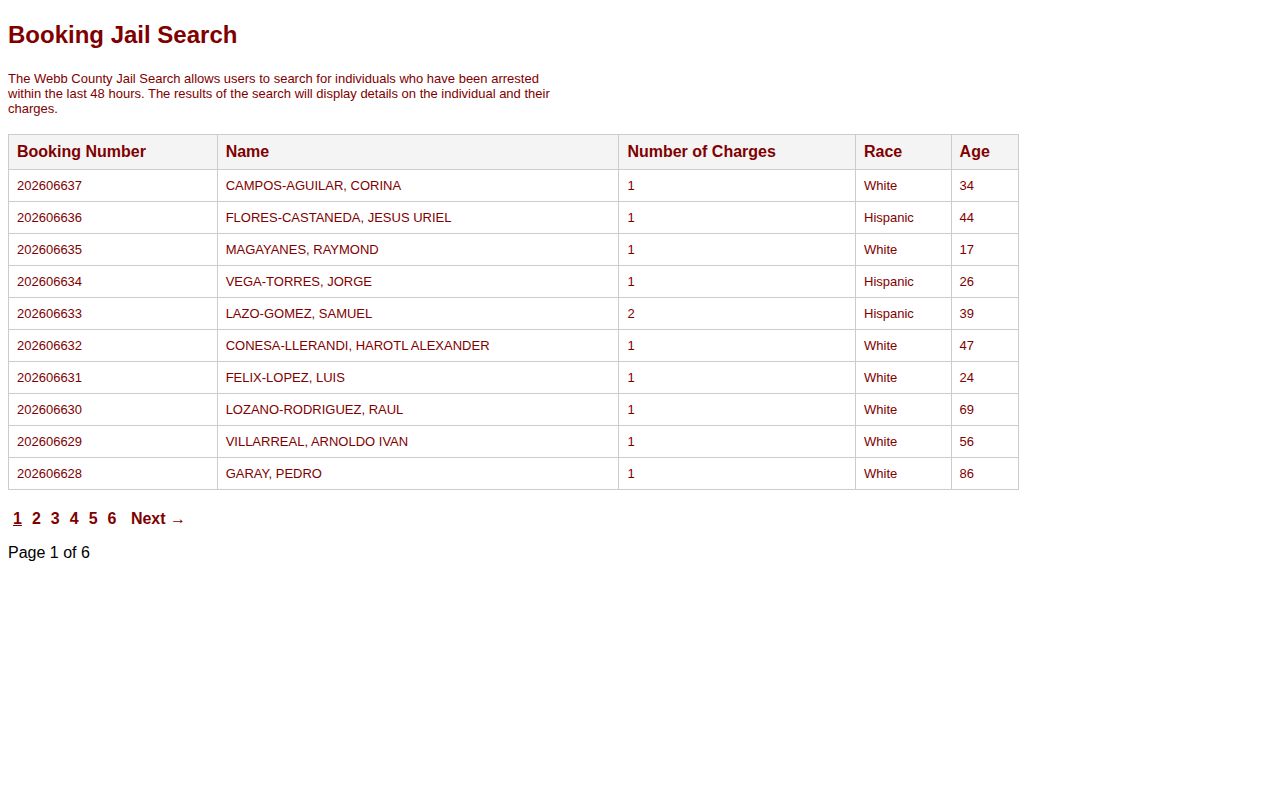
The screenshot should be read by its official label. After locating the booking, switch to VINE, the jail and bond portal, the criminal docket, phone confirmation, or the release-event request.
Webb Release Evidence Compared
Sources do not carry equal weight. A current roster hit establishes only that a participating system reports the person in its custody scope. A court order supplies legal authority but may precede physical processing. An agency release event is stronger proof of departure from that custodian.
| Evidence | What It Establishes | Main Limit |
|---|---|---|
| 48-hour arrest row | A recent arrest record | No release status |
| Bond or court order | Authority or case event | May precede jail processing |
| VINE event | Reported custody change | May lag and needs agency confirmation |
| Release transaction | Dated departure from Webb custody | Must still state release versus transfer |
| Receiving-agency record | Continuation in another system | Uses a different identifier and scope |
TDCJ uses TDCJ and SID numbers. BOP uses a federal register number. ICE commonly uses an A-number. Keep these separate from the Webb booking number so different custody episodes are not merged.
Webb Three-Day Fallback Chain
When the jail and bond portal does not load, do not assume the person was released. During the research check, that portal entered an authentication redirect loop. The correct response is to continue through other official channels. Texas VINE can show county custody events. The Webb criminal docket can explain legal authority. The jail can confirm a completed event. The PIO can process a request for the actual record.
State-prison and federal or immigration records require different systems. The TDCJ Inmate Search applies to a person received into Texas prison custody, not someone only booked and released locally. A federal criminal detainee may move through USMS and later BOP. ICE detention is checked through ICE. In Webb County, where several federal and immigration facilities operate, this transfer check is crucial.
Request Webb Release History
Submit a precise request when the three-day review remains unresolved. Give the person’s full name and aliases, birth date if known, booking number, Webb County Jail, and exact start and end dates. Request the booking sheet, custody history, admission and physical release times, release reason or code, releasing authority, destination, receiving agency, and related bond authorization.
The county public-information form routes a request to the owning office. The Webb Records Management Center stores material but does not fulfill public-document requests. Texas Chapter 552 provides the public-information framework, while exceptions and redactions may apply.
Ask for electronic copies and a cost estimate. The county-posted schedule lists ordinary paper copies at ten cents per page and additional media, labor, programming, overhead, and shipping charges. Since the schedule reproduces an older rule citation, request the current amount before costs are incurred.
Webb Three-Day Case Timeline
A three-day review is most reliable when each source is placed in time order. Record the arrest and booking, any magistrate or judge order, bond action, the jail’s physical release or transfer event, and a later VINE update. The legal order may precede the jail event, while a VINE notice may follow it after agency data reaches the service.
Webb Pre-Trial Services provides a personal-bond, surety, and judicial-order route and supervises eligible defendants after release. Its official page says major cards are accepted for bond releases with a 3 percent service fee, but telephone card payments are not accepted. Check the live terms before payment. Bond-out ends custody for that episode while the case remains pending.
A later court disposition can show dismissal, plea, verdict, judgment, sentence, jail credit, or probation. It explains more than the arrest table, yet it still may not state the physical exit time. Use the release transaction to close that gap.
The three-day period can also cross two reporting cycles. Capture the booking number and each page date when the question is time-sensitive, but do not preserve or republish a list of current arrestees as releases. The purpose is to locate the correct jail episode and obtain the end event from its custodian.
If VINE reports a change near the edge of the window, ask the jail which local date and time belongs to the actual transaction. Then compare it with the court order and any receiving-agency record. This resolves overnight events without guessing which day should contain the person.
Public Record Search
Sponsored Results