
Webb Release Dates by Custody
Start with custody type. A person awaiting trial in Webb County Jail has not yet received a sentence in that case, so there may be no projected release date to calculate. Bond, dismissal, a court order, or transfer can end the jail stay. A person serving a county sentence may have a judgment, jail credit, and a possible sheriff good-conduct calculation. A person received by TDCJ falls under the state’s classification and release framework.
Webb County has no TDCJ prison unit in the official unit directory. A Webb conviction can still lead to a TDCJ unit elsewhere in Texas. Search by the person’s TDCJ or SID number when possible, and do not use the county roster to predict a state-prison release.
Find Webb Projected Release Dates
Gather the full name, birth date, cause number, Webb booking number, and any TDCJ or SID number. Then follow the channel that owns the relevant custody period.
- For a current county booking, check the Webb jail and bond record and the criminal case for status, bond, judgment, and jail credit.
- Call Webb County Jail at 956-523-4400 when a county sentence or hold is unclear.
- For state prison, open the TDCJ Inmate Information Search. Last name is required; first name, TDCJ number, SID, gender, and race can narrow the match.
- Read projected release date separately from parole eligibility date, current status, and maximum sentence information.
- Check the Board of Pardons and Paroles path when parole or discretionary mandatory supervision affects timing.
- Confirm actual departure through a dated release record or agency history.
The Webb County released inmates search covers the full cross-system evidence path when custody may have moved.
Webb TDCJ Date Fields
TDCJ search results may show current facility or status, projected release date, parole eligibility date, offense and county, sentence data, TDCJ number, and SID. Each field serves a different purpose.
| Field | Meaning |
|---|---|
| Projected Release Date | Classification and Records estimate for leaving incarceration if parole does not occur sooner |
| Parole Eligibility Date | The point at which legal eligibility may begin, not a hearing appointment or promise |
| Scheduled Release Date | A later processing date that can appear as release work advances and still can change |
| Maximum Expiration | Sentence endpoint used in some calculations, subject to lawful adjustments |
| Actual Release or Discharge | Historical completed event; discharge means the sentence or supervision obligation ended |
The TDCJ inmate-information help explains other status channels. Historical records may require an email or formal public-information request rather than the live search.
Webb TDCJ Search Screen
The official TDCJ offender search is the right entry point for a Webb County case that resulted in state-prison custody.
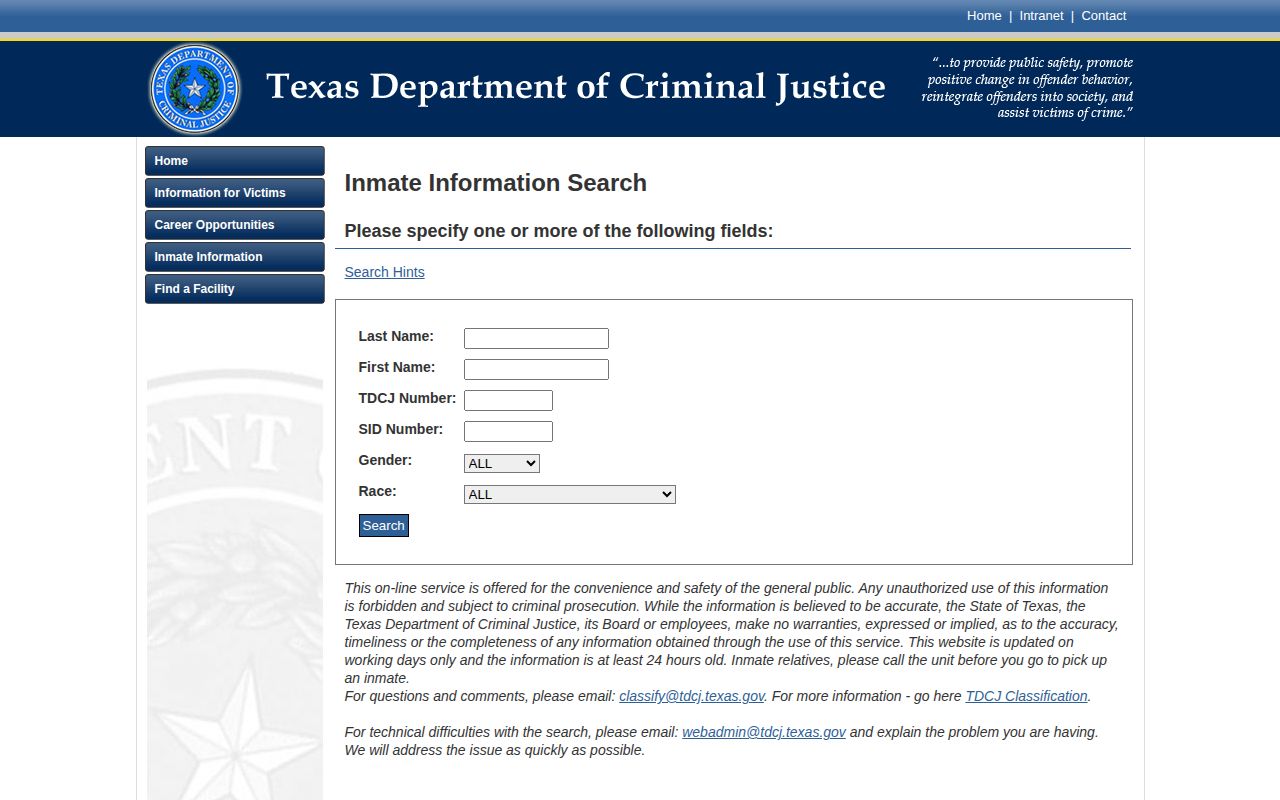
The captured form shows the statewide route. Match the person carefully and read all date labels before treating any one value as expected departure.
Texas Release Calculation Rules
TDCJ defines projected release by offense era and eligibility. For an eligible offense before September 1, 1996, the projection generally reflects the point where flat time plus good time equals the sentence. For an eligible offense on or after that date, mandatory supervision is discretionary. The time equation must be met and the Board of Pardons and Paroles must approve. A denial can reset the projection to maximum expiration, while later approval may move it.
For a person not eligible for mandatory supervision, the projection generally tracks maximum expiration unless parole occurs sooner. Government Code Chapter 508 supplies the governing framework. Section 508.149 lists mandatory-supervision exclusions.
Texas does not impose one blanket “85 percent” rule for every violent offense. Under Section 508.145(f), the general category uses calendar time plus good-conduct time equaling one-fourth of the sentence or 15 years, whichever is less, subject to exceptions. Many serious-offense categories under Section 508.145(d) require calendar time without good-conduct credit equal to one-half of the sentence or 30 years, whichever is less, with offense-specific limits. Exact offense, date, deadly-weapon finding, sentence structure, and prior history matter.
Webb County Jail Good Time
County-jail calculations are not TDCJ calculations. Texas Code of Criminal Procedure Article 42.032 says a sheriff may grant commutation for good conduct, industry, and obedience. Subject to the law and absence of sustained misconduct, the amount can reach one day for each day actually served.
The word “may” makes the credit discretionary. Do not automatically cut a Webb County sentence in half. The judgment, time already credited, holds, and the jail’s lawful calculation all matter. Article 42.033 also permits intermittent off-work or weekend confinement in specified cases. Time outside the jail between segments is not final release. Work release under Articles 42.031 and 42.034 is also temporary absence rather than discharge.
Note: Ask Webb County Jail for its actual calculation instead of applying a statewide slogan to a specific county sentence.
Changes to Webb Release Dates
Projected dates respond to new facts and legal decisions. Some changes move the date sooner, while others move it later or replace it with maximum expiration.
| Change | Possible Effect |
|---|---|
| Good-time class or credit | Changes the applicable earned-time calculation |
| Credit forfeiture | Can move the projection later |
| New sentence or detainer | Can prevent release to the community or require transfer |
| Consecutive sentences | Changes the combined timing calculation |
| BPP approval or denial | Can advance release or reset a mandatory-supervision projection |
| Program or residence condition | Can delay physical processing after a favorable decision |
| Court credit correction | Can change time credited against the sentence |
| Administrative audit | Can correct a previously shown date |
A detainer is a hold or request from another authority. It can turn the end of one custody episode into transfer. A favorable parole vote also may be withdrawn on new information, so the vote code alone does not prove departure.
Verify Webb Actual Release
Treat the date as a forecast until the originating agency records a completed event. For county custody, obtain the Webb release transaction or direct jail confirmation. For TDCJ, check status again and request incarceration history when a durable record is needed. The free TDCJ information email route uses pia@tdcj.texas.gov and asks for the full name plus seven-digit TDCJ number, or exact birth date, approximate age, and conviction county.
A VINE notification can add timely notice. The Webb County VINELink Check explains county alerts and the separate IVSS route for state prison and parole. Pair any notice with the agency record when exact time and destination matter.
Webb Parole Timing Evidence
Parole eligibility is not a hearing appointment, favorable prediction, or release order. The Board of Pardons and Paroles reviews eligible Texas cases and may issue several types of outcomes. FI-1 means release when eligible. FI-2 sets a specified future date. FI-3R and FI-4R require a program transfer or completion before release. RMS concerns mandatory supervision. A denial may set a future review month or direct that the person serve all.
None of those codes alone proves physical departure. Approval can be withdrawn on new information. Before a vote, the BPP status line can provide review status. After a favorable vote, TDCJ Review and Release Processing is the more relevant channel. Program completion, an approved residence, a warrant, or another hold may still affect the date.
Webb County parole supervision after actual state-prison release is handled by the Laredo District Parole Office. Webb CSCD handles court-ordered probation. A parole office assignment can corroborate community supervision, but final discharge is stronger and means the sentence or supervision duty ended.
Webb Sentence Records Reconciled
The Webb criminal judgment can document sentence length, jail credit, concurrent or consecutive structure, and a later correction. Search the county criminal portal by party or cause number and obtain a clerk copy when the exact judgment controls the calculation. Court calendars alone do not establish a release date.
For TDCJ history, request admission date, actual release date, release type, discharge date, and any later return to custody. The free inmate-information route requires the full name and seven-digit TDCJ number, or exact birth date, approximate age, and conviction county. A formal request is appropriate for a fuller departmental record.
Place the judgment, TDCJ calculation, BPP action, and completed release event in date order. This shows whether a change came from credit, a new sentence, a board decision, or processing. It also prevents a projected date from being mistaken for the final event.
Webb County Hold Effects
A detainer is a hold or request from another authority. It can stop release to the community even when the current sentence reaches a projected endpoint. The next event may instead be transfer to TDCJ, federal custody, ICE, or another jurisdiction. Ask the record custodian to identify the receiving agency.
New warrants, bench-warrant movement, consecutive-sentence calculations, program or residence conditions, and administrative audits can all change the date or destination. For a county detainee, the jail and court own those facts. For a state prisoner, TDCJ and BPP do. Keeping the custodian clear prevents a Webb booking date from being mixed with a later state-prison projection.
The offense date matters because Texas mandatory-supervision treatment changed for eligible offenses committed before and after September 1, 1996. The deadly-weapon finding, prior history, and exact statutory category can also change eligibility. A rough calculation that omits those facts is not a reliable Webb projected release date.
Maximum expiration, parole eligibility, projected release, scheduled release, actual release, and discharge should appear as separate entries on the timeline. Maximum expiration marks a sentence endpoint. Eligibility opens a possible review path. Projection is a calculation. Scheduling reflects later processing. Actual release records departure, while discharge records the end of the sentence or supervision obligation.
A person serving only a Webb County jail sentence should not be placed into the TDCJ formula unless the person was actually received by TDCJ. Obtain the county judgment, credit, and sheriff calculation instead. Likewise, a pretrial detainee has no sentence-based maximum expiration in that pending case. Bond or a court order, not earned-time arithmetic, controls the possible exit.
Once TDCJ shows a scheduled date, check again close to the event. TDCJ states that the date and location remain subject to change even on that day. A later agency history is the right source for the actual release type and date.
Public Record Search
Sponsored Results