
Webb County Parole Versus Probation
Parole is conditional release from Texas prison. The Texas Board of Pardons and Paroles makes the release, condition, and revocation decisions, while the TDCJ Parole Division provides day-to-day supervision. Mandatory supervision is another form of conditional state-prison release. Neither means the sentence has been discharged. A TDCJ record may show that confinement ended while the sentence continues in the community.
Probation is imposed by a court. Webb County Community Supervision and Corrections Department, or CSCD, supervises that order. A person can leave Webb County Jail on a probation order without ever entering TDCJ. The court docket is therefore central to a probation check, while the TDCJ inmate detail is central to a parole check.
| Point | Parole | Probation |
|---|---|---|
| Who orders it | Texas Board of Pardons and Paroles after a prison sentence | A trial court |
| Who supervises | TDCJ Parole Division | Webb County CSCD |
| Starting record | TDCJ status and actual release event | Webb court judgment or community-supervision order |
| End point | TDCJ discharge or other formal termination | Court and CSCD completion record |
- Parole
- Conditional release from prison while a state sentence continues.
- Probation
- Court-ordered supervision in the community, called community supervision in Texas.
- Discharge
- The formal end of the sentence or supervision duty, not merely release from a cell.
- Absconder
- A person alleged to have stopped reporting or left supervision without permission.
Check Webb County Release Supervision
Start with the last custodian. If Webb County Jail was the last known location, check the criminal case for a probation order or a commitment to TDCJ. If TDCJ held the person, use the official inmate record and read the current status before calling an office. Name-only matches are weak. Compare the TDCJ or SID number, birth information, offense, county of conviction, and custody dates.
- Open the TDCJ Inmate Information Search for a former state prisoner, or the Webb County criminal record search for a court-ordered probation case.
- Confirm identity with a stable identifier and the Webb County case details.
- Read the status. “Parole” or “mandatory supervision” means active state supervision may remain. “Discharged” is a different and later event.
- Use the listed district office for parole. Use the court order and Webb CSCD for probation.
- Ask for the minimum status needed, including whether physical release occurred and whether supervision remains active.
A favorable Board vote is not physical release. Programs, residence approval, calculations, certificates, or another hold can delay departure.
The full Webb County released-inmate search and the underlying release-record path are on the Webb County released inmates home page. That record should identify the custodian that released or transferred the person.
Webb County Supervision Offices
The local parole and probation offices are separate. TDCJ assigns Webb County to the Laredo District Parole Office. Webb CSCD lists a main office and a South Office. Its own pages conflict on the main phone number, so the current county directory should be checked before relying on either published number.
Laredo District Parole Office
6020 McPherson Road, Suite 6
Laredo, TX 78041
Phone: 956-724-1933
Fax: 956-724-2146
Webb County CSCD
Main: 1110 Victoria Street, Suite 104, Laredo
South: 3802 South Zapata Highway, Laredo
Posted hours: Monday through Thursday, 7:30 a.m. to 5:30 p.m.; Friday, 8 a.m. to 3 p.m.
Published numbers conflict: 956-523-5373 and 956-523-4373
Webb CSCD reports about 3,000 people under community supervision across its offices. That is an office workload figure, not a count of releases or active parole cases.
Texas Parole Review for Webb Releases
Ordinary Texas parole consideration is not a public courtroom-style hearing with a docket date. TDCJ identifies a case before the applicable review point. An institutional parole officer interviews the prisoner and prepares a summary. Three Board members then vote one at a time, and two matching votes decide the case. The Board’s public meetings and minutes should not be confused with an individual prisoner’s review schedule.
The Texas Board of Pardons and Paroles gateway explains the agency’s role. Its decision codes describe the result and, at times, a program or later date. FI-1 means release when eligible, while several other favorable codes require a specified date, transfer, program, or aftercare path. NR, SA, and DMS are forms of denial. Even an approval may be withdrawn when new information arrives.
The official Board gateway pictured below is the starting point for policy and public meeting material, not a bulk Webb County parole-release list.
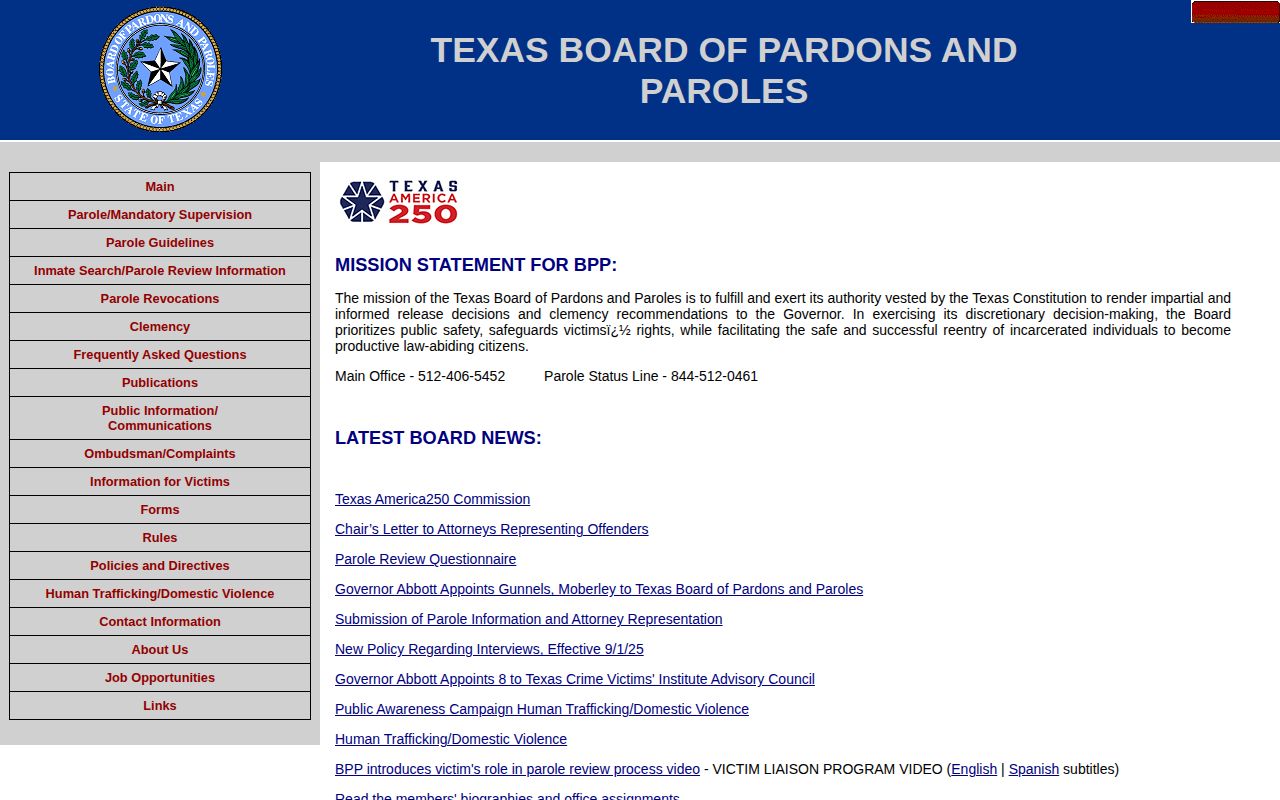
For an individual result, return to the TDCJ status record or use the agency phone channel tied to that stage.
Webb County Parole Release Timing
Before a Board vote, the parole-review status line is 844-512-0461. After a favorable vote, Review and Release Processing can be reached at 512-406-5202. General TDCJ locator and status numbers are 936-295-6371 and 800-535-0283. Callers should have a TDCJ number, SID number, or exact date of birth.
TDCJ’s Ombudsman gives an estimate of about 14 to 21 business days for audit and calculation after Classification and Records receives a release certificate. Some cases dependent on program completion or residence approval may take roughly four to six weeks. These are planning ranges, not promised Webb County release dates. Actual departure needs a dated release event, and later supervision needs a current parole assignment.
Question: Does a parole eligibility date prove release? No. It marks when review may become legally possible. It is not a hearing appointment, favorable prediction, or release order.
Webb County Supervision Violations
Conditions vary by order and case. At a high level they may require reporting, approved travel, programs, or compliance with laws and specific Board or court terms. A violation allegation can lead to a warrant, detention, and a revocation process. It does not erase the earlier physical release, but it may start a new custody episode.
No official Webb County Sheriff absconder list was verified. A person held in Webb County Jail on a parole warrant is still a parole case, not a probation case. Basic supervision or warrant information may be available from TDCJ, while internal parole material and protected victim information are restricted under Texas Government Code section 508.313. Avoid name-only conclusions and do not republish home details.
VINE can report participating county-jail events. TDCJ IVSS is the correct notification channel for prison release, parole decisions, supervision warrant action, discharge, and return to custody. The two systems should not be blended.
Correct Webb County Release Records
Webb County’s Records Management Center stores material for county departments, but it does not fulfill public document requests. A correction must go to the office that owns the disputed event. Send jail-release evidence to the sheriff or county PIO, a judgment issue to the clerk or court, a TDCJ history issue to TDCJ, and a probation-office issue to Webb CSCD.
A narrow request is often faster. Name the existing record, person, identifier, date range, and specific field believed to be wrong. The Records Management page explains the custody distinction, while the county request form routes administrative records. Judicial records follow the clerk route instead.
Discharge is not erasure. An expunction under Texas Code of Criminal Procedure Chapter 55A or an order of nondisclosure follows its own requirements. Release alone does not qualify every case.
Note: Correcting the source record is more useful than asking an unrelated office to interpret a parole, probation, or release event.
When Webb County Supervision Ends
Physical release, supervision, and final discharge are three different points. A Webb County Jail release to probation ends the jail stay but begins court supervision. A TDCJ parole release ends confinement while the state sentence continues. A later discharge indicates the sentence or supervision duty ended according to the responsible agency.
Use a dated record for each step. The jail release transaction proves departure from the sheriff’s custody. The Webb court order identifies the basis for probation. TDCJ status and the district-office assignment support active parole. A final discharge record is stronger than an old projected date or favorable Board code.
Texas VINE records for county custody age out after 90 days following release, so the notification result is not permanent history. For an older Webb County case, preserve the booking number, TDCJ or SID number, and court cause number, then request the actual records from their originating offices.
Public Record Search
Sponsored Results